
S&P Global Ratings Confirms Rwanda's Credit Rating at 'B+/B' with a Stable Outlook

Kigali, Rwanda – 25 May 2026 – S&P Global Ratings last week affirmed Rwanda’s credit rating at ‘B+/B’, maintaining a stable outlook. The affirmation reflects Rwanda’s stable economic conditions and ongoing efforts toward sound fiscal management even amid challenges.
Rwanda’s economic performance reflects steady, ongoing progress. A strong growth reached 9.3% in 2025 from 7.2% in 2024 driven by robust growth across agriculture, industry and services. Growth is expected to ease around 6.8% in 2026 partly reflecting near-term pressures from rising global fuel costs linked to the Middle East situation before gradually improving to an average of 7.1% over 2027-2029. While short-term moderation is expected, the overall growth path remains stable and resilient, reflecting expectations of continued steady economic activity in the medium term.
The report highlights Rwanda's continued investment in strategic infrastructure, most notably the New Kigali International Airport (NKIA), a landmark project set to strengthen regional connectivity, boost tourism, and anchor long-term economic diversification. Construction remains on track, supported by innovative financing arrangements. This reflects Rwanda’s long-term development strategy focused on building capacity and improving regional integration.
Central to this affirmation is Rwanda’s debt structure where approximately 89% of external debt is concessional, contracted at long maturities and low interest rates, keeping debt-servicing costs well within sustainable bounds. Fiscal consolidation efforts continue, underpinned by a growing domestic revenue base and prudent expenditure management. This indicates that debt sustainability remains carefully managed, reducing risks to fiscal stability.
While acknowledging global economic uncertainties and regional pressures including the effects of the Middle East conflict on fuel prices, supply chains, and inflation, the stable outlook reflects expectations that Rwanda’s growth momentum, policy direction, and institutional resilience will continue to support macroeconomic stability over the medium term.
Rwanda’s position as a net oil importer exposes it to global price fluctuations linked to geopolitical tensions in the Middle East. However, proactive measures such as expanding fuel reserves and diversifying supply sources help strengthen stability and resilience. This reflects confidence in Rwanda’s ability to manage external pressures while maintaining overall economic stability.
The affirmation comes as Rwanda continues efforts to strengthen its position as a regional hub for investment, services, and innovation while advancing its long-term development priorities.
More News

RDF DEPLOYS MILITARY ENGINEERS TO SUPPORT INFRASTRUCTURE REHABILITATION IN JAMAICA
Kigali, 14 January 2026
Today, the Rwanda Defence Force (RDF) deployed a contingent of military engineers to Jamaica, a Caribbean island nation, to…

RDF CHIEF OF DEFENCE STAFF HOSTS APR FC TEAM FOR LUNCHEON TO CELEBRATE THE RECENT SUPER CUP VICTORY
Kigali,12 January 2026
The Chief of Defence Staff of the Rwanda Defence Force (RDF), General MK Mubarakh, today hosted APR FC players and technical…

RWANDAN PEACEKEEPERS IN THE CENTRAL AFRICAN REPUBLIC AWARDED UN SERVICE MEDALS
Bria, 7 January 2026
Rwandan peacekeepers deployed in Bria, Central African Republic (CAR), were today awarded United Nations service medals in…
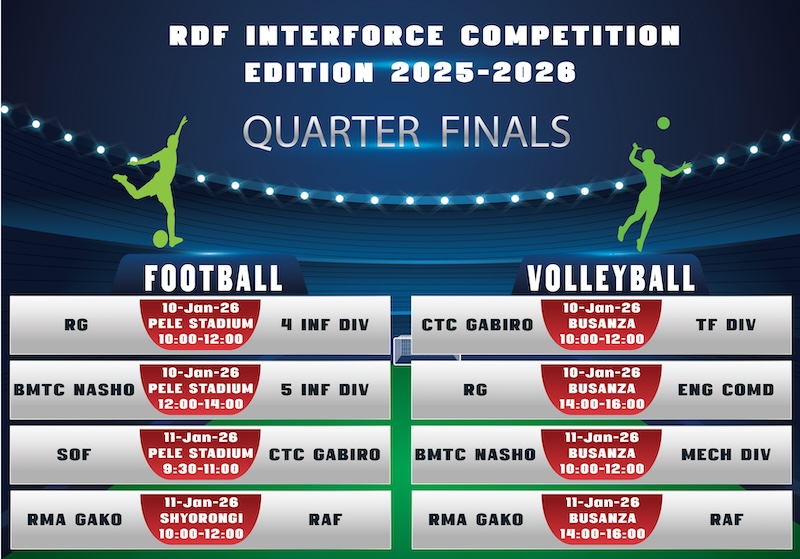
RDF INTER-FORCE SPORTS COMPETITION REACHES QUARTER-FINALS
Kigali, 6 January 2026
The Rwanda Defence Force (RDF) Inter-Force Sports Competition has progressed to the quarter-final stage following a series…

END-OF-YEAR MESSAGE FROM H.E. THE PRESIDENT OF THE REPUBLIC AND COMMANDER-IN-CHIEF OF THE RWANDA DEFENCE FORCE
Kigali, 29 December 2025
Officers, Men, and Women of the Rwanda Defence Force and other Security Organs, as we close another year, I take this moment…

SECURITY ORGANS IN NORTHERN PROVINCE CONDUCT TREE-PLANTING ACTIVITY IN BURERA DISTRICT
Burera, 23 December 2025
Today, joint security forces comprising personnel from the Rwanda Defence Force (2nd Division), Rwanda National Police…

PRESIDENT OF MOZAMBIQUE’S PARLIAMENT VISITS RWANDAN SECURITY FORCES IN MOCÍMBOA DA PRAIA
Cabo Delgado, 23 December 2025
The President of the Parliament of the Republic of Mozambique, Her Excellency Margarida Adamugi Talapa, today visited…

RDF INFANTRY BRIGADE COMPLETES ADVANCED TRAINING COURSE
Kirehe, 22 December 2025
The Rwanda Defence Force (RDF) Infantry Brigade, comprising senior officers, junior officers, and other ranks, has…

RWANDA SECURITY FORCES IN MOCÍMBOA DA PRAIA PARTICIPATE IN PUBLIC SPORTS WITH LOCAL GOVERNMENT OFFICIALS
Cabo Delgado, 21 December 2025
The Rwanda Security Forces (RSF) deployed in Mozambique’s northern province of Cabo Delgado today participated in a…

RWANDA SECURITY FORCE COMMANDER RECEIVES MOZAMBIQUE DEPUTY ARMY COMMANDER IN MOCÍMBOA DA PRAIA
Cabo Delgado, 20 December 2025
Major General Vincent Gatama, Commander of the Rwanda Security Force (RSF) Joint Task Force, today received…