
Rwanda Validates Second National Human Rights Action Plan for 2026/27–2030/31
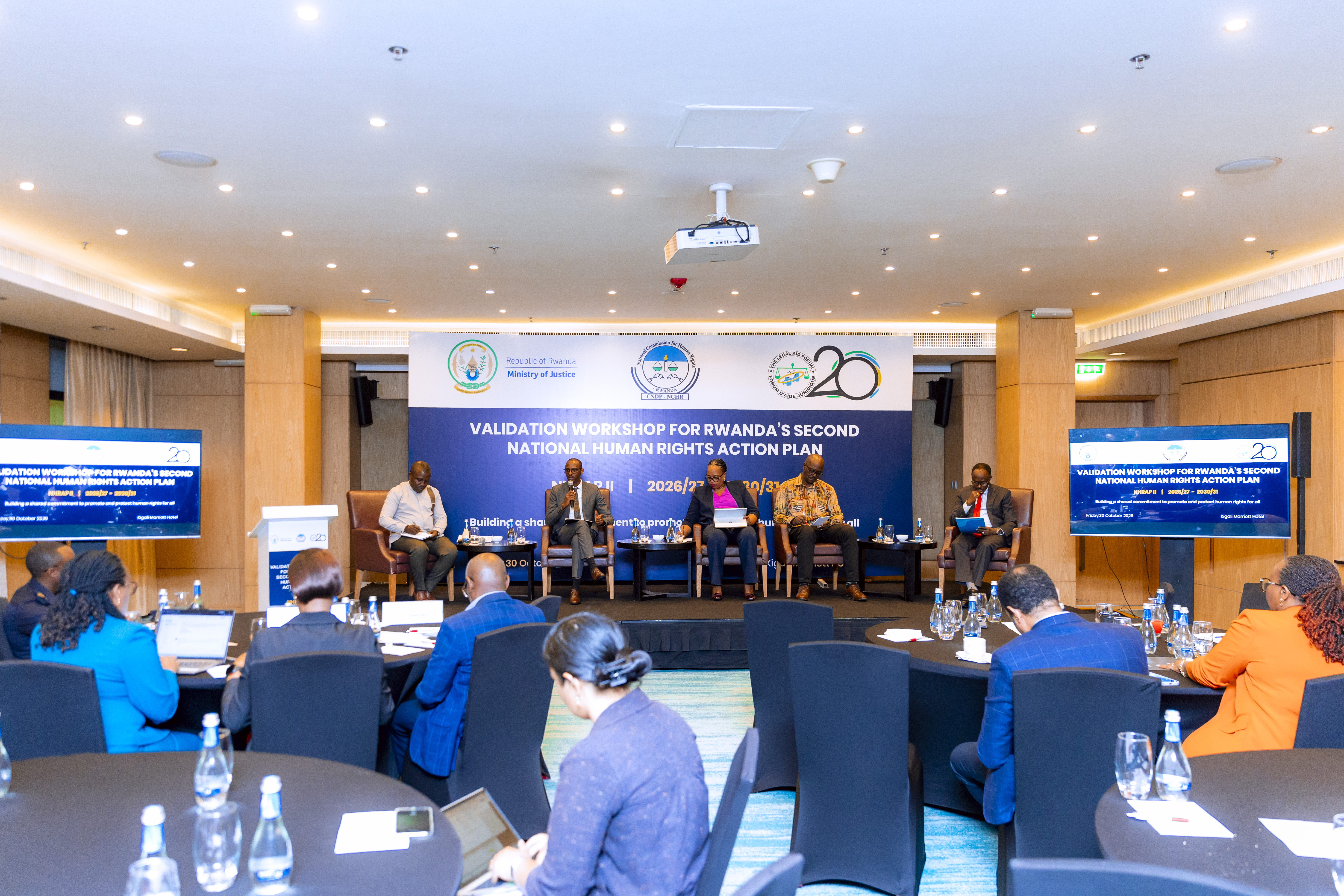
The Ministry of Justice, in partnership with the National Commission for Human Rights and the Legal Aid Forum (LAF), convened a stakeholder validation workshop for Rwanda’s Second National Human Rights Action Plan (NHRAP II), covering the period 2026/27–2030/31.
The workshop, held on 30 October, brought together representatives of government institutions, civil society organisations, the private sector, development partners, academia, faith-based organisations and the media to review and validate the Plan.
In her keynote address, the Permanent Secretary and Solicitor General, Umuzayire Burayobera Bibiane, highlighted the importance of the Plan in providing a common framework for coordinated action, with clearly defined responsibilities and measurable targets to guide implementation and assess progress.
He noted that the second Plan builds on the achievements and lessons of the first National Human Rights Action Plan while expanding its scope to give dedicated attention to business and human rights, human trafficking and climate change. These areas require coordinated responses across institutions and sectors because of their implications for people's dignity, safety and livelihoods.
The Plan is aligned with the Constitution of Rwanda, Vision 2050 and the Second National Strategy for Transformation (NST2), reinforcing the integration of human dignity, equality and inclusion into the country's development agenda. It also provides an opportunity to strengthen coordination in following up on recommendations from Rwanda's Universal Periodic Review (UPR) and human rights treaty bodies.
The Permanent Secretary and Solicitor General emphasized that Rwanda's commitment to human rights is rooted in its history, particularly the lessons of discrimination, exclusion and the 1994 Genocide against the Tutsi. This history, the address noted, places a responsibility on all institutions to protect the dignity of every person, confront discrimination and ensure equal protection and opportunities for all.
The address further stressed that the success of the Plan will be measured by its impact on people's lives, particularly those in vulnerable situations, through improved access to essential services, protection against violence and exploitation, effective remedies for human rights violations and meaningful participation in decisions that affect them.
Stakeholders were encouraged to ensure that the validation process produces an Action Plan that responds to people's needs, assigns clear institutional responsibilities and establishes a sound basis for monitoring results.
"National ownership must become institutional responsibility, and institutional responsibility must translate into improvements in people's lives," the Permanent Secretary and Solicitor General emphasised.
More News

PRIME MINISTER PRESIDES OVER SWEARING-IN CEREMONY OF NEW MILITARY HIGH COURT OFFICIALS
Kigali, 10 December 2024
The Right Hon. Prime Minister, Dr. Edouard Ngirente, officiated the Swearing-In Ceremony of newly appointed officials for…

Sergeant Minani Gervais arraigned in Military tribunal for killing 5 civilians in Nyamasheke district
Nyamasheke, 3 December 2024
Sergeant Minani Gervais was arraigned before a military tribunal today on murder charges related to the deaths of five…

RDF AND UPDF AGREE ON STRATEGIES TO DETER NEGATIVE ACTS AFFECTING BORDER COMMUNITIES
Musanze, 30 November 2024
The RDF and UPDF concluded today their third Proximity Commanders meeting in Musanze. They agreed to implement strategies…

RDF AND UPDF HOLD A PROXIMITY COMMANDERS MEETING IN MUSANZE
Musanze, 28 November 2024
The Rwanda Defence Force (RDF) is hosting the third Proximity Commanders meeting with the Uganda Peoples’ Defence Forces…

Rwandan female peacekeepers and partners launch a campaign against Gender-Based Violence
Bria, 25 November 2024
The Female Engagement Team of Rwanda Battle Group VI, operating under the United Nations Multidimensional Integrated…

RWANDA SECURITY FORCES COMMANDER AND MOZAMBIQUE CHIEF OF GENERAL STAFF VISIT LIBERATED MUCOJO COASTAL TOWN
Cabo Delgado, 23 November 2024
The Joint Task Force Commander of the Rwanda Security Forces (RSF), Maj Gen Emmy K. Ruvusha and the Chief of General…

RDF 5 Division secures victory in friendly football match against TPDF 202 Brigade
Ngoma, 20 November 2024
The Rwanda Defence Force (RDF) 5 Division football team emerged victorious with a 2:0 score in a friendly match against the…

RWANDA HOSTS EAST AFRICAN COMMUNITY MULTI-AGENCY EXPERTS WORKING GROUP MEETING
Kigali, 18 November 2024
From 18 to 20 November 2024, experts from East African Community (EAC) partner states gathered in Kigali, Rwanda for the…

RDF SUPPORTS LIVESTOCK FARMERS IN EASTERN PROVINCE
Gatsibo, 13 November 2024
The Rwanda Defence Force (RDF) has launched a program to assist livestock farmers in the Kayonza, Gatsibo, and Nyagatare…
ITANGAZO RIGENEWE ABANYAMAKURU
REF:RDF/DPA/A/10/08/24
Kigali, 13 Ugushyingo 2024
Ingabo z’u Rwanda (RDF) zibabajwe n'ibyago byabereye mu kabari ko mu Kagari ka Rusharara, Umurenge…