
MINEMA Strengthens Rwanda’s Preparedness for CBRN Emergencies Through Tabletop Exercise

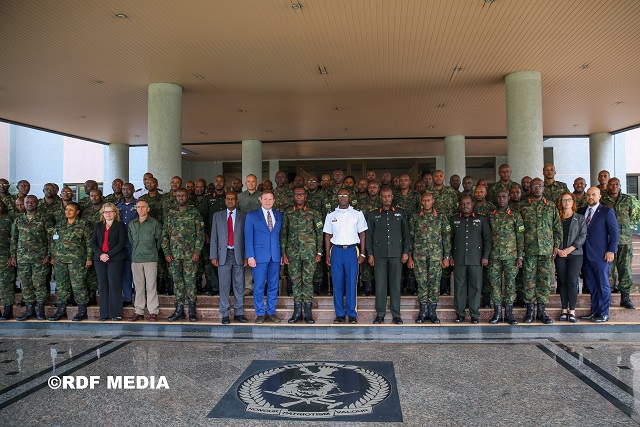
Participants and facilitators pose for a group photo at the close of the Exercise.
The Ministry in Charge of Emergency Management (MINEMA), in collaboration with the European Union Chemical, Biological, Radiological and Nuclear Centres of Excellence (EU CBRN CoE) Initiative, conducted a three-day CBRN Tabletop Exercise from 18 to 20 August 2026 to strengthen Rwanda’s preparedness and coordinated response to chemical and radiological emergencies.
The exercise, conducted under Project 106 of the EU CBRN CoE Initiative, brought together representatives from relevant government institutions and members of the national CBRNE Task Force. It was technically facilitated by experts from the United Kingdom and Kenya.
The scenario-based exercise provided participants with an opportunity to simulate a complex CBRN emergency and test national preparedness and response arrangements. Participants assessed command and control mechanisms, inter-agency coordination, incident reporting and decision-making processes, while identifying areas requiring further improvement.
The exercise also enabled institutions to assess existing policies, plans and Standard Operating Procedures (SOPs), as well as the availability and effectiveness of personnel, training, equipment, communication and logistics arrangements required during a CBRN emergency.
Through the simulation and discussions, participants identified key capability gaps, including the need for clearer roles and responsibilities among responding institutions, stronger multi-agency coordination, regular joint exercises, improved incident reporting and decision-making tools, and enhanced interoperability of communication systems and equipment.
Delivering the closing remarks, Permanent Secretary at MINEMA, NGOGA Aristarque, commended the participating institutions and technical experts for their active engagement throughout the exercise. He noted that Rwanda has considerable experience in preparing for and responding to more familiar hazards such as floods, earthquakes and volcanic eruptions, while CBRNE risks require specialised preparedness and response capacities.
“We are accustomed to dealing with disasters caused by rainfall, earthquakes and volcanic eruptions, but CBRNE risks appear to be relatively new to us.”

PS NGOGA emphasised that the tabletop exercise provided an important opportunity for institutions to strengthen their readiness to manage the complexities associated with CBRNE incidents by testing existing capabilities, strengthening coordination and identifying gaps before an actual emergency occurs.
He urged participating institutions to draw lessons from the exercise and translate the findings into concrete actions to improve national preparedness. He further recommended revisiting the national CBRNE Action Plan to ensure that it incorporates the lessons learned and addresses the capacities and systems required for an effective response to CBRNE emergencies.
The exercise highlighted the importance of effective coordination among institutions with different mandates and responsibilities in preventing, preparing for and responding to CBRNE incidents. Participants worked through evolving scenarios requiring timely information sharing, coordinated decision-making and effective command and control, providing an opportunity to identify practical challenges that could affect response operations during a real incident.
The gaps identified during the exercise covered policies and plans, SOPs, personnel, training, equipment, communications and logistics. The exercise also reinforced the need for regular joint simulations to maintain institutional readiness and strengthen cooperation among first responders and other relevant agencies.
The identified gaps and recommendations will be consolidated and shared with the Regional Secretariat under the EU CBRN CoE framework to facilitate further technical support and contribute to strengthening Rwanda’s national CBRN preparedness and response capacity.
The CBRN Tabletop Exercise forms part of Rwanda’s continued efforts to strengthen disaster preparedness and build a resilient, disaster-ready nation capable of responding effectively to both familiar and emerging risks. By testing preparedness arrangements in advance, the exercise enables institutions to identify weaknesses, develop solutions and strengthen the systems required to protect lives, communities and the environment in the event of a CBRNE emergency.
More News

EAC CIMIC Tanzania, Uganda contingents pay homage to Genocide victims
Kigali, 1 July 2019
Contingents from Tanzania and Uganda who are in Rwanda for one-week East African Community Armed Forces medical outreach this…

Rwanda Defence Force hosts EAC Armed Forces Medical Outreach
28 June 2019
Rwanda Defence Force (RDF) along with contingents from Kenya, South Sudan, Tanzania and Uganda are conducting a one-week East African…
RDF pledges medical support as EASF takes over the African Union Standby Force
Nairobi, 20 June 2019
Rwanda Defence Force (RDF) has pledged to provide medical support for the Eastern African Standby Force (EASF) as the body…
RDF Peacekeepers share lessons learned
Kigali, 20 June 2019
Rwanda Defence Force (RDF), in partnership with the United States Institute of Peace and various other partners, is conducting a…


RDF trains South Sudanese, assists in community work
Malakal & Juba
Rwandan peacekeepers of Rwanbatt-2 (RDF 71 Infantry Battalion) serving under the United Mission South Sudan (UNMISS) in Malakal (North…

Senior officers from ten countries graduate at RDF Command and Staff College
Musanze, 7 June 2019
Forty-seven (47) Senior Officers from Rwanda Defence Force (RDF), Rwanda National Police and nine other allied Armed Forces from…

Gabiro Combat Training Centre students visit Genocide memorial site
Kigali, 1 June 2019
290 company course, platoon commanders’ and platoon sergeant course students from RDF Combat Training Centre in Gabiro this…

47 Senior Officers due to graduate from RDF Command and Staff College
Musanze, 31 May 2019
ACOS, Lt Gen Mupenzi awarding student Maj YU Gabarin from Nigeria.
Rwanda Defence Force Command and Staff College (RDFCSC) is…

120 RDF soldiers of First Division (1Div) complete Section Commanders’ course
Kigali, 31 May 2019
A total of 120 RDF soldiers made up of Sergeants, Corporals and Privates have today completed a three-months section…